

Prices, Specifications & 360° Interactive
Pontiac Fiero - Price, Specs and 360° Interactive
Pontiac Fiero - 360° Interactive
Pontiac Fiero - Key Specifications
Pontiac Fiero Specifications
| Specification | Details |
|---|---|
| Type | Mid-Engine Sports Coupe |
| Released At | 1984 Model Year |
| Built At | Pontiac, Michigan, USA |
| Engine | 2.5L I4 / 2.8L V6 (varies by model) |
| Position | Mid-Engine, Transverse |
| Aspiration | Naturally Aspirated |
| Block Material | Cast Iron |
| Valvetrain | OHV, 2 Valves per Cylinder |
| Fuel Feed | Throttle-Body / Multi-Port Fuel Injection |
| Displacement | 2473 cc / 151 in³ (I4) – 2836 cc / 173 in³ (V6) |
| Power | 92 – 140 hp / 69 – 104 kW |
| Specific Output | 37 – 49 hp per liter |
| Torque | 185 Nm / 136 lb-ft (V6) |
| Top Speed | 180 – 200 km/h / 112 – 124 mph |
| 0 – 60 mph | 7.9 – 9.5 seconds |
| 0 – 100 km/h | 8.1 – 9.8 seconds |
| Body / Frame | Steel Spaceframe with Plastic Body Panels |
| Driven Wheels | RWD (Rear-Wheel Drive) |
| Wheel Type | Cast Alloy or Steel Wheels |
| Front Tires | 185/75R14 – 205/60R15 |
| Rear Tires | 185/75R14 – 215/60R15 |
| Front Brakes | Ventilated Discs |
| Rear Brakes | Discs (from 1985 onward) |
| Front Wheels | 14 x 6.0 in / 15 x 6.0 in |
| Rear Wheels | 14 x 6.0 in / 15 x 7.0 in |
| Front Suspension | Independent, MacPherson Strut |
| Rear Suspension | Independent, Trailing Arm / Chapman Strut |
| Curb Weight | 1130 – 1240 kg / 2491 – 2734 lbs |
| Weight Distribution | Front 43% / Rear 57% |
| Wheelbase | 2373 mm / 93.4 in |
| Length | 4176 mm / 164.4 in |
| Width | 1737 mm / 68.4 in |
| Height | 1194 mm / 47.0 in |
| Transmission | 4-Speed Manual / 5-Speed Manual / 3-Speed Automatic |
| Fuel Economy (Combined) | 8.5 – 10.0 L/100 km / 23 – 28 mpg (US) |
| Fuel Capacity | 48 liters / 12.7 gallons |
Some Interesting Pontiac Fiero Facts
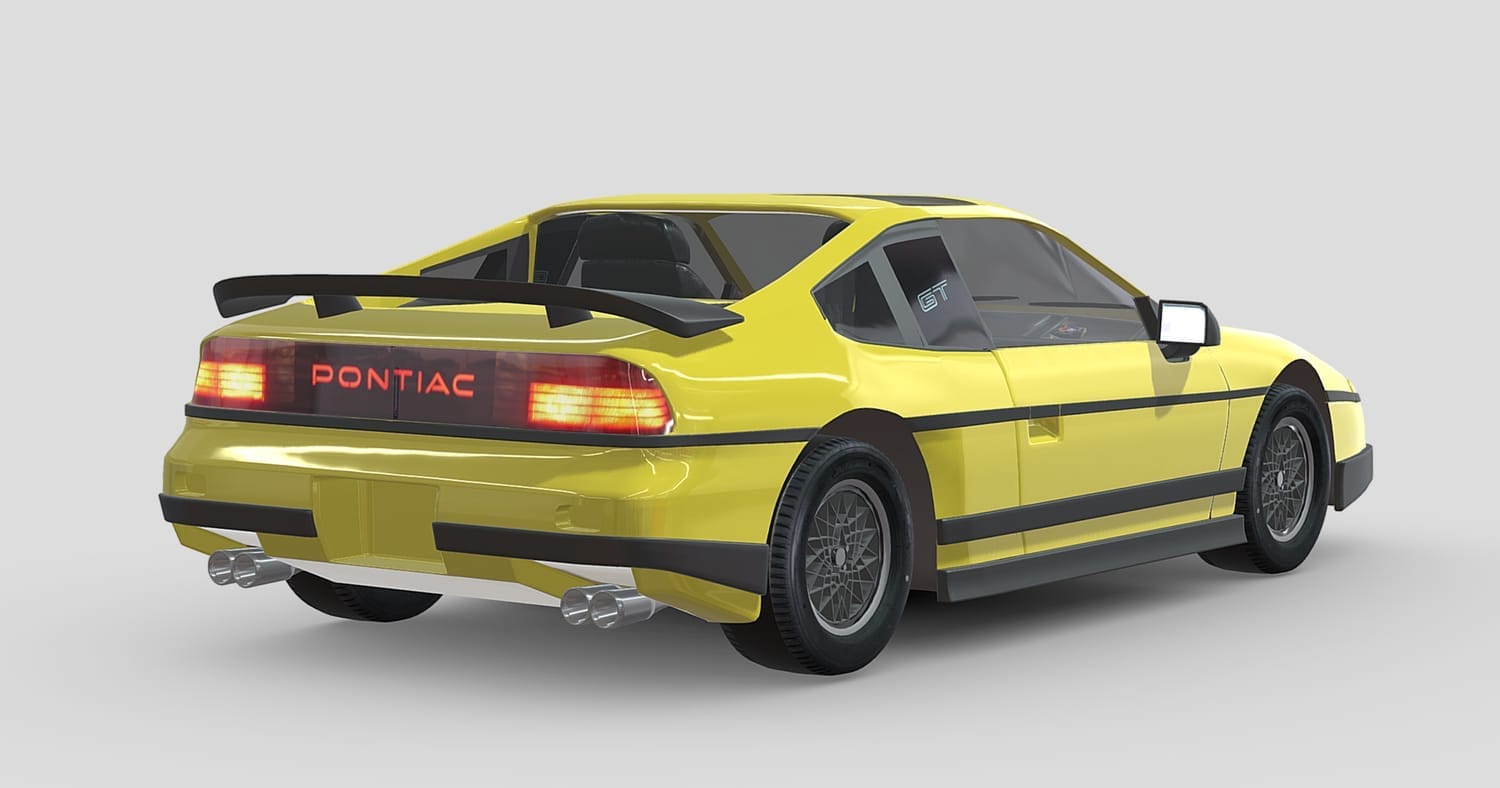
GM’s First Mid-Engine Production Car The Pontiac Fiero, introduced in 1984, was the first mass-produced mid-engine sports car by an American automaker, making it a standout in Pontiac’s lineup and U.S. automotive history.
Designed as a Fuel-Efficient Commuter Car Despite its sporty looks, the Fiero was originally marketed as a fuel-efficient two-seater commuter car, not a full-blown performance vehicle. Its Iron Duke 4-cylinder engine prioritized MPG over speed.
Plastic Body Panels Over a Steel Space Frame The Fiero used non-load-bearing composite body panels over a steel frame, making it lightweight, rust-resistant, and easy to repair—a revolutionary design for its time.
Later Models Offered V6 Power In response to criticism about lackluster performance, Pontiac introduced a 2.8L V6 engine in 1985, boosting horsepower to 140 hp in the GT models and giving the Fiero more sports car credibility.
GT Fastback Styling Became Iconic In 1986, the Fiero GT received a fastback design, giving it a sleek, Ferrari-inspired look that became the most popular and collectible Fiero body style.
Award-Winning Safety and Design The Fiero won numerous awards, including Motor Trend’s 1984 Car of the Year, and earned high marks in crash safety tests, partly due to its rigid space frame.
Early Models Suffered from Reliability Issues Some 1984 Fieros experienced engine fires due to oil leaks and low oil capacity, which tarnished the model’s reputation early on—even though GM later resolved the issue.
Used in Kit Cars and Ferrari Replicas Because of its mid-engine layout and simple frame, the Fiero became a favorite base for Ferrari, Lamborghini, and custom kit car replicas, especially during the 1990s.
Production Ended in 1988 with Major Improvements The 1988 Fiero GT featured a new suspension design, bigger brakes, and much-improved handling—but just as it reached its peak, GM discontinued the model.
Now a Cult Classic Although misunderstood at launch, the Pontiac Fiero has become a cult classic, especially among collectors, tinkerers, and mid-engine enthusiasts, with values steadily rising for clean, original examples.
Pontiac Fiero Price

The Fiero was America's bold mid-engine experiment – a plastic-bodied, budget-friendly sports car. While not as valuable as European exotics, well-preserved examples are gaining cult status.
Here's the EU market breakdown:
1. Price Ranges (EUR, Mid-2024)
By Model & Condition
Base Model (2.5L I4, 92hp)
Project Car: €3,000 – €6,000(Needs engine/body work)
Driver-Quality: €6,000 – €12,000(Running, minor flaws)
Show-Quality: €12,000 – €20,000
GT/GTS (2.8L V6, 140hp)
Project: €5,000 – €10,000
Restored: €10,000 – €18,000
Concours: €18,000 – €30,000
Special Editions (GTP, Indy Pace Car)
Add 20–40% premium(Extremely rare in EU)
2. Key Value Factors
✅ Engine Type
V6 models (1985–1988) command 2x I4 prices
Engine swaps (LS, Northstar) hurt collector value
✅ Body Condition
Plastic panels crack but don't rust – check mounting points
"Fiero Creak" (chassis flex) is normal
✅ Rarity in EU
Only ~500 estimated in Europe
LHD models dominate (no factory RHD)
3. Where to Buy?
Classifieds: Mobile.de, Marktplaats
Clubs: Fiero Owners Club Europe (best for parts/advice)
US Imports: Add €3k–€5k for shipping/taxes
4. Market Outlook
📈 Sleeping Classic
Prices up 8–12% yearly since 2020
Last American mid-engine car until C8 Corvette
⚠️ Watch For
Cooling system failures (caused factory recalls)
1984 models (worst build quality)
(Fun Fact: The Fiero's spaceframe chassis inspired the C8 Corvette!)
Pro Tip: Verify VIN codes – early models (W = Willow Run plant) have more issues than later Pontiac-built cars.
(Bonus: The Fiero's optional "Comptech" body kit was designed by the same firm that did Lamborghini Countach prototypes!)
Need help authenticating? Share photos of:
Engine bay stampings
Door jamb VIN plate
Rear suspension (V6 models have unique mounts)
You might also like:
Contact Details YourCar360:
Vliet 115, 8446LX, Heerenveen, The Netherlands
webmaster@yourcar360.com